We’re all being encouraged to buy local this Christmas, now more than ever given the impact of Covid-19 on small businesses in 2020. Other media outlets are doing a great job of highlighting fantastic products, made in Ireland from imported materials, but having a sustainability focus I’ve decided to showcase products made in Ireland from locally sourced materials.
In writing this article I realised that not every ‘Irish’ material is indeed Irish. I often see Irish linen cited only to find out that the fibre is grown in France and woven in Ireland. I appreciate that the fabric is ‘made’ in Ireland but I suspect that a lot of customers assume it’s grown here too.
Okay, I’ve given up and am posting a Christmas article in October! Such madness, but this is definitely a mad year, so I’m going with it.
Christmas is the most damaging time of the year environmentally, what with all the additional journeys taken (less than usual this year maybe!), food wasted and extra consumption. It’s ironic that one of the most joyous times of the year is threatening the existence of humans on this planet – but we can change that and here are some ideas on how to go about doing so.
I often hear the excuse / complaint / declaration that living more sustainably is a privilege. What on earth does that mean? Does it mean that people in crisis haven’t the time or headspace to make changes in their life? Well, duh! I’d hope that people in such situations have the common sense to scroll past posts on how to cook from scratch or mend their clothes until they emerge from their crisis. If it means that sustainability is only for people with lots of disposable income, then bullshit!
Nothing mentioned in this article has been sponsored. It’s all just my own personal opinion. If you like your sources to remain independent then please;
Perhaps this fallacy lies in the misconception that living more sustainably means that you HAVE TO buy organic food and clothing, or HAVE TO cycle everywhere, or HAVE TO grow all your own fruit and veg. Firstly there are no HAVE TO’s in sustainable living, there are simply options – some that will suit and some that won’t. Secondly the supply chain for goods in our over-developed world is so complex that there’s often no way to be 100% sure that one item is more sustainable than another without doing a Life Cycle Analysis (LCA) for each product for each location! When I’m in danger of getting lost in ‘the weeds’ of comparing products, I pull back and focus on what I know to be 100% true; less consumption = sustainable. A mantra that suits this budget conscious citizen very well.
4 Rs: Refuse, Reduce, Reuse and Rehome Reducing consumption is actually quite straightforward, and quite addictive once you get going! All you need is to live by the 4 Rs; refuse, reduce, reuse and rehome. Firstly refuse any freebies you get offered, reduce the quantity of stuff you buy, reuse what you already own before buying a replacement and rehome what you don’t need to others that do. You might have notice that none of those Rs cost any money, in fact quite the opposite, they save you money.
Personally I’ve found the refuse option easy peasy and if I think someone is going to interpret refusal as an insult I add in the statement that ‘we’re a zero waste household trying to reduce our consumption’. That seems to soften the blow.
Reducing what we buy not only frees up lots of money, it also frees up a lot of time, both in terms of shopping and tidying up! Having less stuff means having less to wash / tidy / dust / store / repair / move. It also makes it so much easier to find things so I spend less time looking for lost items. This R is really crucial when it comes to shopping. Over consumption, even of second-hand goods is unsustainable. Don’t fool yourself into thinking that your 3rd t-shirt purchase of the month is sustainable if it’s pre-loved or organic cotton. Too much is too much, period!
Reuse, for me, is probably the most powerful of these 4 R’s. I was always the type of person that wore clothing and shoes to death. It just seemed wasteful to replace perfectly good items just because some in the fashion industry said they were dated! What is new to me is reusing other people’s stuff. Prior to our journey to sustainability is never occurred to me to wear clothing owned by others, or to borrow something instead of buying it, or to take stuff from skips that were useful to me. In the beginning I was a bit worried about people’s reactions but having estimated that such actions save us €2000 annually that embarrassment has dissapated. It’s a sad state of affairs when the norm in society is to hand over our hard-earned cash to store or dispose of goods that we bought with our hard-earned cash. Remember all that stuff in the bin or skip used to be money!
Rehoming is another R I’m passionate about. There is nothing more wasteful that leaving something sitting in a press or wardrobe unused for years, especially electronics as they go out of date really quickly. Giving something you’re not using, even as a loan, is one of the most sustainable things you can do. Even after refuse, reduce and reuse I constantly have a basket in my hall with items in need of a new home. This is partly because I don’t donate to charity shops. I buy in them and donate money to them, but knowing just how much of the donations end up in landfill I prefer to rehome items to individuals directly. I do make exceptions to my ‘rehoming’ rule. My weight fluctuates quite a bit and so rather than re-buy different sizes when it does I keep hold of clothes from my skinny, fat and middling eras!
I purposely left repair off the list of R’s in this article because unless you can repair something yourself and already have all the tools to do so, repair can be very expensive. It maddens me that this is the case and think we should lobby politicians hard to change it. I do appreciate that repairing something can save you money in the long run but currently I can buy a barely-worn boots in a charity shop for less than €10 whereas re-soling an existing pair costs me €25. That’s not to say that I don’t re-heel and resole shoes, I do, but for someone on a tighter budget that might not be an option.
Cleaning One of the biggest money saving switches for us was ditching all those proprietary cleaning products. Now we only buy toilet cleaner, washing up liquid, dishwasher tablets and washing powder. Everything else is cleaned with damp rag with maybe some bicarbonate of soda or vinegar. Not only did we save a fortune but my asthma cleared up.
I’ve noticed huge disparities between prices for eco cleaning products and equipment so definitely hunt around for the best value. I’ve seen coconut scourers on sale for €2 in one shop and €4 a few hundred yards up the road. The cleaning products we buy are comparible in price to what you’ve find in Tesco, Dunnes or Supervalu. We tried cleaning products from Lidl and Aldi but they caused breathing difficulties and rashes in our house. Our washing powder by Sonnet is the most expensive item we buy. It’s comparible in price with Persil. When we lived a high-consumption life we wouldn’t have been able to afford this but because we’ve reduced the amount of washing we do, and overall cost of cleaning products we can now. To find out more about how we clean check out my article on Sustainable Ethical Cleaning
Shopping for Food We’ve become accustom to low-cost food in Ireland. If you don’t believe that it is low-cost just compare the cost of food in relation to salaries in Ireland to other countries. I appreciate that this doesn’t meant everyone in Ireland can afford food, which is a terrible indictment of successive governments in this country. If I was dictator for a day our entire food system would be reconfigured to ensure a reasonable profit to farmers and retailers, at a price that made a weekly shop of healthy food affordable to anyone on the average wage. But I digress, this article isn’t aimed at people who can’t currently afford to feed themselves. They’ve enough stress in their life without having to worry about living more sustainably.
In my experience it is far cheaper to eat healthily in Ireland than it is to eat unhealthily. By that I mean it is far cheaper to buy the ingredients for a home cooked meal, made from scratch, than it is to buy ready-prepared meals or sauces. It’s even cheaper if you reduce the amount of meat in them or cut it out altogether.
Just a note before I leave the issue of food. If you’re regularly putting food that could have been eaten into the bin you can afford to spend more money on it. Believe you me, you will not allow a €20 organic chicken to end up the brown bin.
I will also say that organic or local-grown food or groceries at farmers markers aren’t always more expensive than what you find in supermarkets. If you buy in season you’ll be able to save yourself money at the farmers market and get better quality healthier food to boot.
Shopping for Non-food Items If you’re on social media you’d be forgiven for thinking that living sustainably requires you to exclusively buy from artisans and independent retailers. Eighty percent of what we buy in our house is from charity shops, most of which started life in high-street stores so my family pretty much looks like every other family in the neighbourhood. The only difference being is that we’ve generally paid a tenth of the price my neighbours have for their clothes. If you’d like to have a go at this check out this list of second-hand stores and websites in Ireland
If we do need something specific or new we always try to buy from makers directly, then from independently-owned local stores, but sometimes the budget won’t stretch that far and I have to buy a ‘less-bad’ item on the high-street. That’s not to say that independent stores or makers are always more expensive. You’d be surprised at how competitively priced some suppliers can be, so always take a look.
In some areas though it’s just not feasible for me to go the route of maker / independent store. Take kids clothes for example. I really can’t afford to pay €50 for organic pyjamas that my children will only get 6 months wear out of. I would consider investing in them as Christmas presents if there was a healthy resale market but I’ve really struggled to sell on second-hand kids clothes in Ireland. For this reason I still do quite a bit of shopping on the high-street. I know that buying from non-Irish retailers isn’t as good for our economy as buying from Irish companies so if the sale price in an independent retailer is <30% of the high street and it’s long-lasting item, and I can afford the difference, I’ll generally pay the extra.
I will add that buying more sustainable / ethical options on the high-street isn’t without its benefits. An order for organic cotton from a boutique label is fantastic, but an order for organic cotton from a fashion chain can have hugely positive knock on effects. Every time you buy a ‘better’ version of a product in a high-street store you’re saying ‘yes please’ to more of this and that ‘vote’ translates into more orders of the same. Is it ideal to be buying items shipped from across the world and made by people living below the poverty line? No, of course not, but life isn’t ideal, and we’re just doing the best we can with what we have.
On my travels of the high street I’ve spotted a few positive moves by some brands / stores. Some are accessible at full retail price but for some I’d be waiting for sales or buying second-hand.
Aldi – stainless steel lunch boxes (special promotion items)
Lidl – organic cotton bedlinen and clothing for adults and kids (special promotion items), also does well priced recycled toilet paper
Barefoot footwear brand Vivo now sell pre-loved shoes via the website Revivo
Tumi – recycled bags made from post-industrial fabric scraps collected from factory floors
Samsonite – have a range of bags partially made from recycled PET bottles.
Irish company Sportshouse and global brand Jansport both offer lifetime guarantees on their bags.
Eastpak – sell two ranges of bags made from recycled polyester with vegetable tanned leather trims. They also offer a 30 year warranty.
The Great Outdoors gives you a discount on new kids wetsuits when you return one of their to them.
If I’ve missed any out please let me know in the comments. One great tip mentioned in the comments is to buy kids clothes a few sizes ahead. Like them I’ve found by rolling up the ends of trousers and sleeves a child can wear a garment for up to 3 years. I would also suggest avoiding gendered or themed clothes when buying new if you can. It can really helps with hand-me-downs to other kids.
Utilities Because we reduce the amount of waste we create, have a compost bin and rehome as much as possible our waste bin charges are about a 1/3 of our neighbours. Currently we spend about €100 on bin charges and I’m eager to get that down further.
Car We have an electric car, and although it was an expensive purchase, even second-hand, it’s saved us a huge amount of money in terms of fuel and tax. An electric car won’t suit everyone and not owning a car is far more sustainable than owning an electric one.
Also what with insurance and repairs, having a car is an expensive business. So one way to save yourself a fortune is to forgoe owning one and to use liftshare and car share services. To find out more read my article on How to Avoid Buying a Car
Quick Fixes If you’re in the mood for some instant gratification I’ve previously written a lovely list of free and easy steps to sustainability . There’s a few steps in there for you to tick off without even getting up from your seat!
A little lockdown love has resulted in plenty of pandemic pregnancies and the promise of a bounty of bounce-back babies come next January. If that applies to you, congrats! I’ve got pretty much every aspect of parenting covered on this website so if you want to be a planet-positive parent fear not. That’s not to say that I’m knocking sustainable parenting out of the park – far from it – but we keep trying.
Nothing mentioned in this article has been sponsored. It’s all just my own personal opinion. If you like your sources to remain independent then please;
Sleeping I’m going to start with what should be the most important part of a bedroom, the bed. For our kids we used a moses basket, then a cot and then straight to a single bed with a bed rail. In my opinion toddler beds are a waste of money and resources, but maybe your cot converts to a toddler bed or you can lay your hands on a good one second-hand.
Moses Baskets – These are generally only used for a few months and an be picked up in good condition from friends or family, or second-hand online. See my list of Second Hand Stores in Ireland for leads. If you do get a second hand one it might be wise to change the mattress. See below for more info. If you do want to buy new then I think the moses baskets by Dublin based Sahara are just stunning. The baskets are made by artisans in sub-saharan Africa using naturally dyed elephant grass. The goal of the Ghana born owner of Sahara is to pay artisans 50% of the profits from each sale.
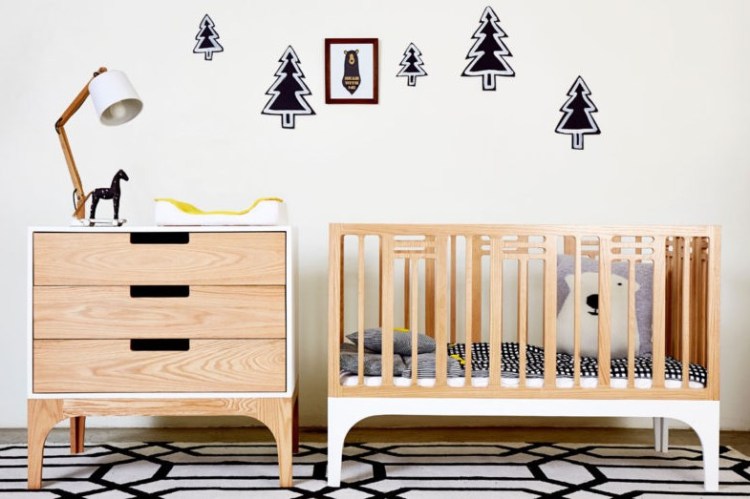
Cots – I’m so excited to have just found the most stunning sustainable cot and nursery furniture made right here in Ireland. Bunny and Clyde make beautifully designed pieces in FSC (Forest Stewardship Council) or PEFC (Programme for the Endorsement of Forest Certification) certified hardwood, and formaldehyde-free FSC certified birch plywood using glues and finishes that are water and plant-based, non-toxic, solvent free.
If they’re beyond your price range then I suggest is to buy second-hand where possible and then for new, look for a wooden one made from a sustainably managed forest (FSC certified or similar) with a natural oil finish if at all possible.
Bed Frames – The most sustainable bed frame is one that already exists so aim to buy second-hand if you can. Sure with a new mattress a bed frame can be as good as new. My son currently sleeps in a deadly racing car bed that only cost us €60 on adverts.ie. If you can’t find something to suit pre-loved I have a list of sustainable ethical beds listed in this article.
If all else fails and you’re stuck with buying on the high-street then opt for a metal bed frame if you can. Metal is long-lasting and infinitely recyclable in most countries. Timber frames are great in theory because the plant absorbs carbon while it grows making it potentially carbon neutral but often the source of the timber is unclear so you may be contributing to the destruction of virgin forests by buying it. Plus it’s often coated with synthetic lacquers and varnishes making it unsuitable for composting and only really fit for landfill or incineration at the end of it’s life.
Mattresses So it’s no secret that I’m a lover of second-hand, but I do make exceptions; underwear, pyjamas, and mattresses (unless the mattress is very lightly used by someone I know). This is particularly important when it comes to cot mattresses. I bought a new cot mattresses for my firstborn, which her brother slept on too, so I was concerned when I learned how a study in 2002 linked second-hand mattresses to an increased risk of Sudden Infant Death Syndrome (SIDS). Interestingly the original study was criticised by child health experts, whose analysis of the data showed no increased risk in the sharing of mattresses between siblings in smaller families. Still buyer beware.
When it comes to new mattresses it’s very hard for consumers to choose a sustainable option in Ireland. We really doesn’t have a fully circular recycling / disposal system for mattresses so regardless of what the mattress is made of it’ll end up being incinerated at the end of it’s life. Sure the metal components might go for recycling but there is no facility to compost the natural materials or recycle the synthetic materials. Also because practically all mattresses are treated with fire retardant (FR) chemicals they really shouldn’t be composted, or recycled – or even incinerated for that matter. FR chemicals have been a cause of concern for decade now with many now calling for them to be banned as happened in California. Interestingly only Ireland and the UK treat upholstered furniture and mattresses with FR chemicals, continental Europe seems to do fine without it. There are a few mattress makers with products that don’t require FR chemicals and I’ve listed them below.
The other issue with mattresses from a health point of view is volatile organic compounds (VOCs). These are chemicals that off-gas from new materials at room temperature and are typically what people describe as that ‘new’ smell from cars and furniture. VOC’s may cause long-term damage to health, particularly children’s health. Synthetic foams, like those found in most mattresses, tend to give off a lot of VOC’s, so one way to reduce the load is to opt for natural materials instead. That said latex, which is often used as an alternative to foam can cause an allergic reaction in some.
Standard Sized Mattresses – You can see a full list of eco mattresses brands in a previous article on Sustainable Ethical Bedrooms, two of which I’m happy to report are completely free of chemicals. One made in the UK and one made in China for an Irish brand.
Bedlinen The question of what to put on your child’s bed is a lot more straightforward. Your choices include second-hand or organic cotton. I’ve given a list of places to source second-hand above so here’s a list of brands of organic cotton bedlinen for babies and kids.
Earthmother (Ireland – organic cotton by Little Green Sheep)
Devon Duvets (UK) – British wool cleaned without chemicals in cotton cover, made in UK,
Paint I mentioned VOC’s above, well those bad boys re-emerge when talking about paint. Most people aren’t aware but standard paint is really just liquid plastic with some pigment in it and as such it emits VOC’s into the atmosphere like any other plastic. Some high-street brands now offer low VOC’s versions but I find I still get flu-like symptoms when we use them. For a list of lung-friendly eco paint brands click this link.
Rugs Okay this isn’t one for vegans or vegetarians but some people swear by sheepskin rugs for babies, which you can now buy from Irish company Rough Circle.
Celtic and Co in the UK sells wool blankets and sheepskin rugs. Their rugs are handmade in Cornwall and use a by-product of the food industry that would otherwise go to waste. They use sustainable natural and organic fabrics and they aim to source as much as possible in the UK in order to keep their carbon footprint as low as possible. They recycle widely in the company and print all catalogues and promotional literature on FSC (Forest Stewardship Council) certified paper, and offer a Carbon Neutral delivery service.
If you’d prefer the look of sheepskin without killing an animal check out ‘Oo without the Oh’ rugs by Hart of Shetland, which are made from just the shorn fleece of the animal.
Accessories Kids grow out of things so quickly, so think twice before rushing to buy theme accessories linked to the latest kids blockbuster. These date so quickly and become impossible to rehome. Better to buy timeless items that look cute and don’t age as badly. Personally I think paper crafts are a fantastic way to decorate a kids room without breaking the bank or the planet. I am totally in love with the template for a 3D card whale from Balincraft. Imagine that hanging from the ceiling of a kids’ room!
Online marketplaces can be a great place to find accessories for kids rooms. They’re generally in perfect condition and available for very little. I’ve even got a few on my own Pre-loved Homeware page on Adverts.
Another great idea for cute decorations for kids rooms is themed sweet and biscuit tins from post supermarkets. I kid you not! (Like the pun?) I have some beautifully designed and made sweet and biscuit tins from Marks & Spencer adorning my kids’ rooms. The charity shops are awash with these come January so keep an eye out.
Storage Be careful with storage, it can hide a multitude of sins. If you need more than one toy box you’re in danger of being left with a load of toys that you just won’t be able to rehome in the future. When it comes to toy boxes I’d go for a sturdy wooden wooden but pay particular attention to the closing mechanism. You do not want tiny little fingers being trapped in a badly designed box!
At some stage a book case would be nice, and a floor mounted model that your child can access themselves is ideal. It doesn’t have to be big. We use a large basket on the floor.
In my experience baskets are the best way to store kids stuff. Cardboard boxes break too easily and plastic storage containers fade and can be very quick to crack into sharp pieces when little bodies lean on them. Even if some storage containers do survive they’re generally scuffed too much to rehome meaning most get binned. I find well-made baskets wear the best and last the longest and if they do break you just have to put them on the compost heap or in the brown bin. Naturally Irish made baskets using locally grown materials will be the most sustainable to buy, but they’re often beyond the price range of most parents. They can also be a bit spikey for a kids room so my preference for bedroom storage is water hyacinth. It’s not as robust as wicker or willow but it’s softer and if you’re crafty you can customise it. Plus water hyacinth is an invasive species outside its natural home of the Amazon so if you buy from other places you’ll be helping those countries protect their local biodiversity. Interestingly all baskets are handmade so whichever one you buy you’ll be helping to provide a livelihood for a craftsperson.
Bedroom furniture wise there really isn’t anything being sold in Ireland as particularly sustainable or ethical so if you can’t buy second-hand aim to buy as locally-made as possible. And if you can, try to get a natural oil or wax finish that you can sand back and re-finish yourself if needs be. I would suggest avoiding kidish wardrobes etc. You’ll be surprised just how quickly they grow out of them and you’ll be faced with rehoming them. I’m also not a big fan of built-in wardrobes. They’re expensive and nine times out of ten they get ripped out and binned after 10-15, and because they’re bespoke there is no chance of rehoming them. Better to invest in a good quality standalone wardrobe that can be restyled or rehomed if needs be.
Blinds or Curtains There is a catch 22 to blackout blinds in a babies room. Some say that having pitch-black rooms leads to babies who can’t fall asleep elsewhere. I don’t know about that. As a desperately tired parent I tried everything to help my kids sleep longer. Nothing work but that’s a article for a different type of website!
Black-out fabric can be applied to any blind or curtain, but be warned, the light will still seep in around the edge of the blind or curtain. The only product I came across that completely blocked out all light was the Gro Anywhere Blackout Blind. Using this frees you up to choose blinds and curtains without black out lining.






 living lightly in ireland